

OCD Therapy
Break Free From the OCD Cycle
Evidence-based online OCD therapy in Ontario using Exposure and Response Prevention (ERP) to help you spend less time stuck in intrusive thoughts, compulsions, and endless “what ifs”, and more time living your life.
Does It Feel Like Your Brain Is Constantly Asking, “But What If…?”
Maybe you check something one more time — just to be sure.
You replay a conversation in your head, trying to figure out if you said something wrong.
You Google the same question again, hoping this time you'll finally find an answer that makes the anxiety go away.
Or an intrusive thought appears completely out of nowhere and suddenly you're wondering:
“Why did I think that?”
“What if that thought means something about me?”
“How can I be 100% sure?”
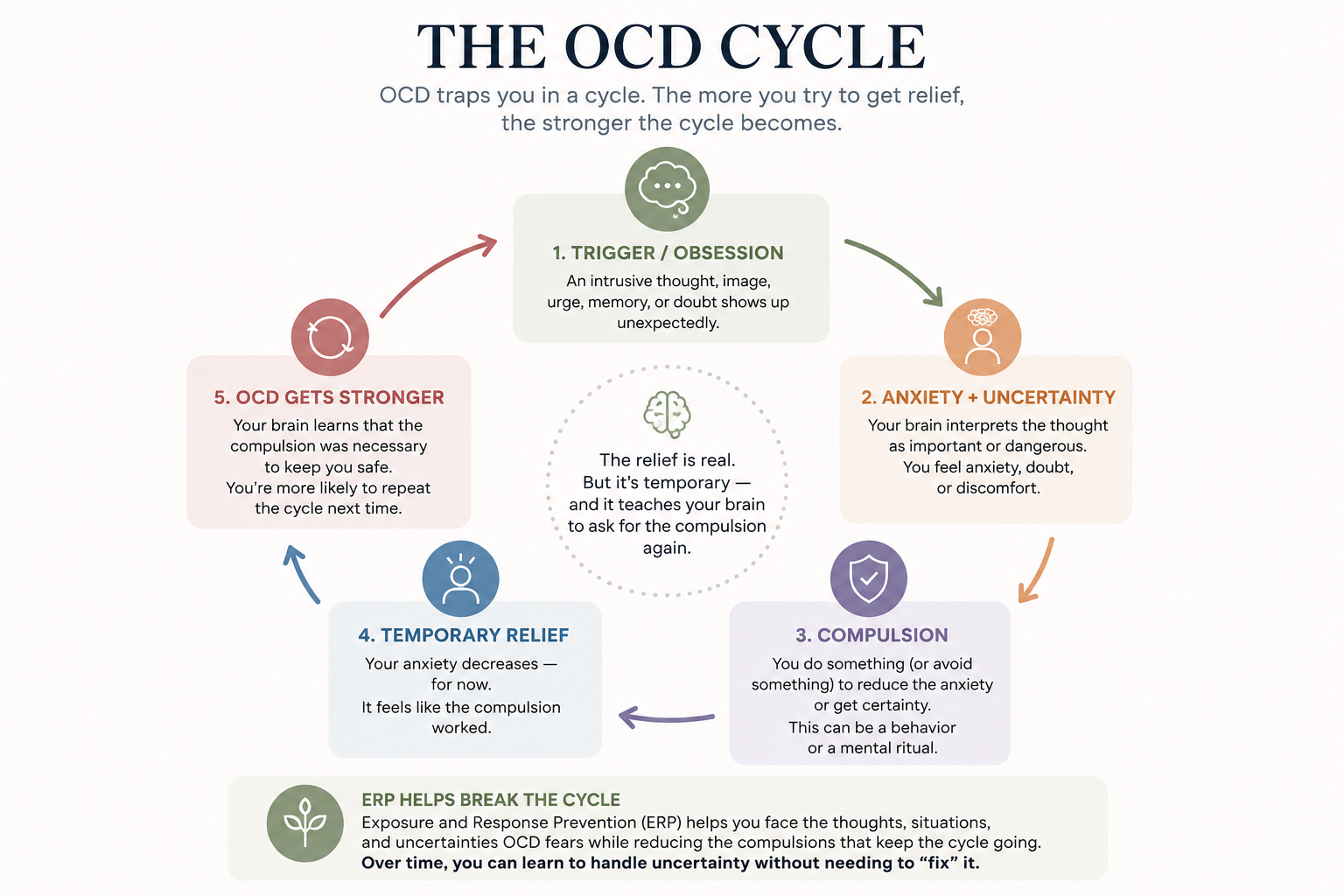
So you check. Analyze. Avoid. Research. Confess. Ask for reassurance. Or try desperately not to think about it. And maybe you feel better… for a little while. Then another doubt appears and the cycle starts all over again.
That's the OCD cycle.
And while you may not be able to control every thought that pops into your mind, you can learn to change how you respond to it.
OCD Can Take Many Forms
OCD Sub-types & Themes
OCD isn't defined by the topic of an intrusive thought. The underlying cycle of obsessions, anxiety, uncertainty, and compulsions can show up around many different themes.
You may experience one theme, several themes, or notice that OCD changes themes over time.
-
Fears involving germs, illness, bodily fluids, chemicals, dirt, contamination, or spreading something harmful to another person. Compulsions may involve excessive washing, cleaning, avoidance, changing clothes, or seeking reassurance.
-
Persistent doubts that something wasn't done correctly or that something dangerous may happen. This can include repeatedly checking doors, appliances, emails, work, driving, belongings, or other situations.
-
Unwanted intrusive thoughts, images, or fears about accidentally or intentionally causing harm. These thoughts can be extremely distressing precisely because they conflict with the person's values.
-
Persistent doubts about a relationship, your feelings toward your partner, your partner's feelings, attraction, compatibility, or whether you've chosen the "right" relationship.
-
Obsessions involving religion, faith, morality, sin, blasphemy, or fears of offending God. Compulsions may include excessive praying, confessing, reassurance seeking, repeating rituals, or trying to achieve certainty about moral or religious questions.
-
Persistent fears about being immoral, dishonest, offensive, irresponsible, or a "bad person." This can involve repeatedly reviewing past behaviour, confessing, apologizing, researching ethical questions, or seeking reassurance.
-
Persistent fears about having, developing, or overlooking an illness. Compulsions can include body checking, symptom searching, medical reassurance seeking, comparing symptoms, or avoiding health-related information.
-
A strong sense that something feels incomplete, uneven, incorrect, or "not quite right," leading to repeating or adjusting behaviours until the feeling changes.
-
A need for objects, actions, words, numbers, or movements to feel symmetrical, balanced, ordered, or exact.
Imagine Having More Room for Your Life
Imagine noticing an intrusive thought without spending the next hour trying to figure out what it means.
Leaving the house without going back to check.
Sending the email without rereading it twenty times.
Feeling uncertainty without immediately asking someone else what they think.
Making decisions based on what matters to you instead of what makes OCD feel safest.
Recovery doesn't require achieving perfect certainty.
It means building your ability to live your life even when certainty isn't available.
What is OCD?
What are common symptoms of OCD?
Obsessive Compulsive Disorder (OCD) is a mental health condition characterized by obsessions and compulsions. Obsessions are unwanted, intrusive thoughts, images, urges, sensations, or doubts that can create significant anxiety or discomfort. Compulsions are behaviours or mental rituals used to reduce that discomfort, prevent a feared outcome, or gain a sense of certainty.
OCD can look different from person to person. Common symptoms may include intrusive thoughts, repeated checking, reassurance seeking, excessive cleaning or washing, avoiding certain situations, mentally reviewing past events or conversations, researching or Googling for certainty, repeating actions until they feel “just right,” or becoming stuck trying to answer persistent “what if?” questions.
Although compulsions may provide temporary relief, that relief can reinforce the OCD cycle and make the urge to perform the compulsion stronger the next time uncertainty appears.
How can therapy support OCD symptoms?
OCD is treatable, and Exposure and Response Prevention (ERP) is an evidence-based, first-line psychological treatment for OCD.
ERP helps you gradually approach the thoughts, situations, sensations, or uncertainties that trigger OCD while learning to reduce the compulsions you typically use to feel safer or more certain.
Rather than trying to prove that an intrusive thought isn't true or eliminate anxiety altogether, therapy can help you build greater tolerance for uncertainty, respond differently to intrusive thoughts, reduce compulsive behaviours and mental rituals, and regain time and energy that OCD has been taking from your life.
The goal isn't to never have another intrusive thought. It's to reach a point where those thoughts have much less power over what you do next.
How Can STC Therapy help?

At STC Therapy, OCD treatment is personalized to you rather than simply treating the theme of your intrusive thoughts.
Using Exposure and Response Prevention (ERP) alongside evidence-based therapeutic approaches, we'll work together to understand your individual OCD cycle, identify obsessions, compulsions and avoidance patterns, and gradually practice responding to uncertainty in new ways.
Therapy is collaborative and moves at a pace that considers your individual needs and goals. Whether OCD shows up as contamination fears, checking, harm-related intrusive thoughts, relationship doubts, scrupulosity, health concerns, mental compulsions, “just right” feelings, or another OCD theme, you'll have a space where you can talk openly about what you're experiencing without judgment. STC Therapy offers accessible online OCD Therapy in Ontario.
The goal is simple: less time answering OCD's demands for certainty, and more freedom to make decisions based on the life you actually want to live.
Frequently Asked Questions
-
No, having a diagnosis can help create clarity for yourself but we can get started treating the symptoms you are experiencing regardless of a formal diagnosis.
-
Getting started is simple. Reach out through our contact form or schedule a a free consultation. We’ll walk you through the next steps and answer any questions along the way.
-
Exposure and Response Prevention is a form of Cognitive Behavioural Therapy used to treat OCD. ERP involves gradually approaching feared thoughts, situations, sensations, or uncertainty while practicing reducing the compulsive responses that maintain the OCD cycle.
-
ERP should be collaborative and individualized. Treatment involves developing an understanding of your OCD patterns and creating exposures that are appropriate to your goals and treatment plan. The purpose isn't to overwhelm you, but to help you build your capacity to respond differently to OCD.
-
Compulsions aren't always visible. Mental reviewing, analyzing, checking your feelings, repeating phrases internally, neutralizing thoughts, and trying to "figure something out" can all function as mental compulsions. ERP can target these patterns too.
-
OCD is treatable. Evidence-based treatments such as ERP can help people significantly reduce the impact OCD has on their lives. Treatment isn't about promising that you'll never experience another intrusive thought, it's about changing how you respond when those thoughts and feelings appear.
-
STC Therapy provides secure virtual psychotherapy, allowing you to attend sessions from a private space without needing to travel to an office.