
OCD: What is it and What is NOT?
When many people hear the term “OCD,” they picture someone who likes things to be organized, washes their hands frequently or prefers everything to be done in a particular way.
In reality, obsessive-compulsive disorder can be much more complex and much more distressing.
OCD can involve intrusive thoughts, images, sensations or urges that feel frightening, shameful or completely inconsistent with who you are. It can also lead to repetitive behaviours, mental rituals, reassurance seeking and avoidance that gradually take up more of your time and interfere with your daily life.
If you are experiencing symptoms like these, you do not need to wait until you have a formal diagnosis to reach out for support. STC Therapy provides virtual OCD therapy for individuals across Ontario, including people living in Halton, Burlington, Oakville, Milton, the Greater Toronto Area and the Waterloo Region.
What is OCD?
Obsessive-compulsive disorder, commonly known as OCD, is a mental health condition involving obsessions, compulsions or both.
Obsessions are recurring and unwanted thoughts, images, urges, doubts or sensations that cause distress. Although most people occasionally experience unwanted thoughts, someone with OCD may become stuck trying to understand, control, neutralize or gain certainty about them.
Compulsions are behaviours or mental acts a person feels driven to perform in response to an obsession. Compulsions are usually intended to reduce anxiety, prevent something terrible from happening or create a sense that things are safe, certain or “just right.”
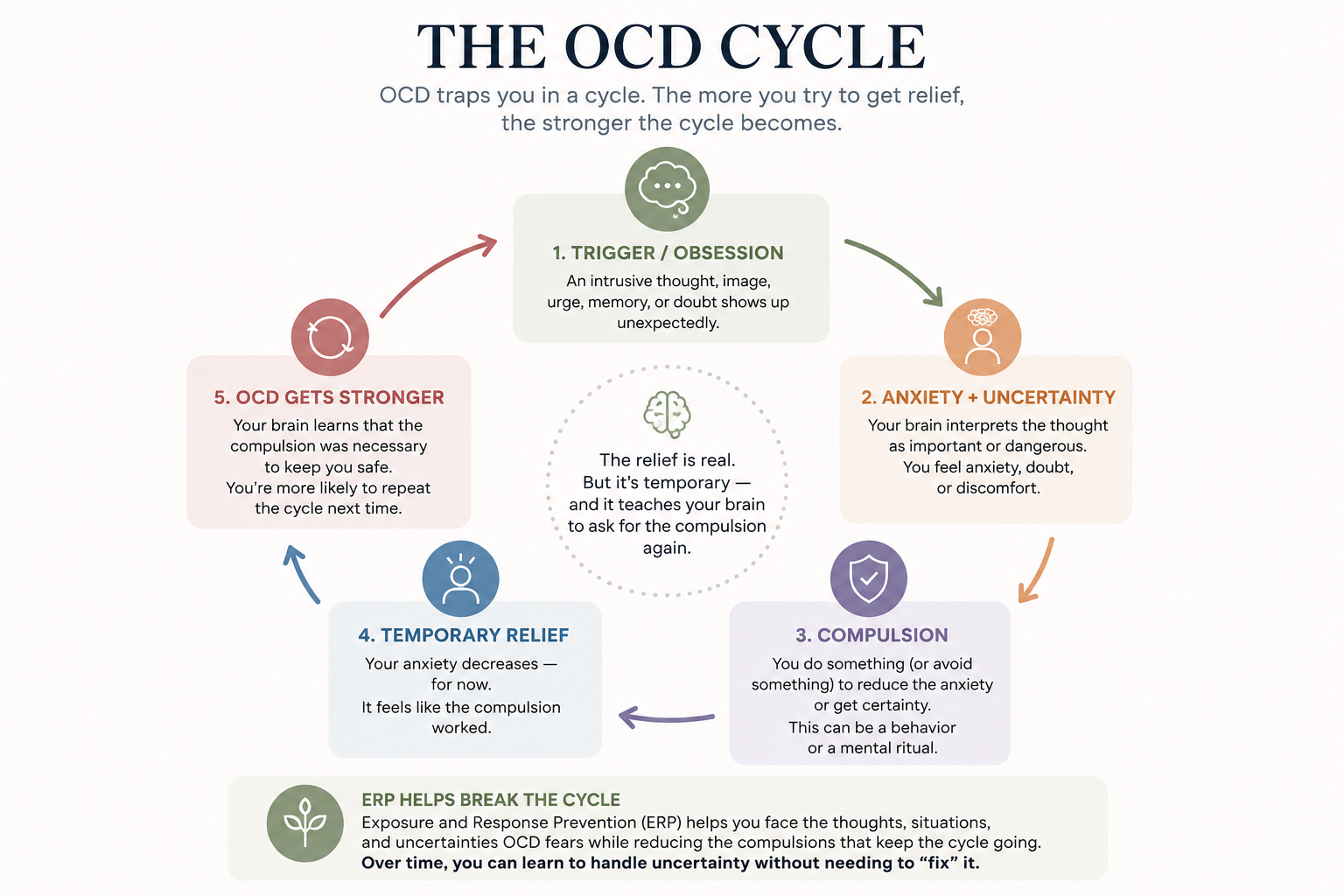
Compulsions can provide temporary relief. However, that relief teaches the brain that the compulsion was necessary, strengthening the OCD cycle over time.
The OCD Cycle might look like this…
1. An intrusive thought, image, sensation, urge or doubt appears.
2. The person experiences anxiety, disgust, guilt, uncertainty or distress.
3. They perform a physical or mental compulsion to feel safer or more certain.
4. The distress temporarily decreases.
5. The brain learns to rely on the compulsion the next time the trigger appears.
Although compulsions can be visible, many happen entirely inside a person’s mind. Someone can therefore be experiencing significant OCD symptoms even when the people around them do not notice anything unusual.
What OCD is NOT:
OCD is not simply being organized, clean, perfectionistic or particular.
A person may enjoy colour-coding their calendar, keeping a clean home or following a detailed routine without having OCD. The difference is not the behaviour alone. It is the distress, urgency and perceived consequences connected to it.
With OCD, a person may feel that they must complete an action, answer a question or achieve certainty to prevent harm, reduce distress or feel “right.”
OCD is also not:
● A personality quirk
● A preference for cleanliness
● The same as perfectionism
● The same as obsessive-compulsive personality disorder
● A sign that someone secretly wants their intrusive thoughts to happen
● A lack of willpower
● Something a person can simply stop thinking about
Intrusive thoughts are not the same as intentions. In fact, OCD frequently targets the things a person values most, which is one reason the thoughts can feel so upsetting.
STC Therapy offers virtual OCD therapy across Ontario, including support for people in:
● Burlington and the Halton Region
● Oakville
● Milton
● Hamilton
● Toronto and the Greater Toronto Area
● Kitchener, Waterloo and Cambridge
● Other communities throughout Ontario
Because appointments are virtual, you can access therapy for OCD from a private and convenient location without having to travel to an office.